
Warrandyte Festival
The Warrandyte Festival will be held on Friday 27th – Saturday 28th March. WCA will have a display and we hope to see our members there. The display will feature
- our recent publication, Bev Hanson – Very Warrandyte,
- information on why Warrandyte has remained such a special environmental enclave in a world of over-development,
- our recent achievements in caring for and supporting the Warrandyte community and our festival blackboards to capture your feedback on what you love about Warrandyte
It’s an opportunity to renew your membership and find out how you can get involved.
We need people for the festival tent roster. Please email Jan on info@warrandyte.org.au if you can spare an hour between 9 and 5 on Saturday.

Bev Hanson – Very Warrandyte
Our recent publication on Bev Hanson’s life and contribution to Warrandyte and beyond, has been very successful and we are into our third print run. If you missed out, copies will be available from the WCA at the Warrandyte Festival on 27-28 March, and at the Warrandyte Historical Society in Yarra Street.
The Main Yarra Trail Missing Link
Manningham Council has put the development of the shared path from Pound Road to Taroona Avenue on hold. This is to allow consideration of the information that they gained from the consultation session, the report on current usage of the trail from Beasley’s to Pound Road, arborical assessments, Department of Transport and Planning response and additional submissions from individuals and groups. Council officers had completed initial work on the engineering aspects of the project, but there are four other relevant areas of Council that need to have input into the project. We will not know the outcome of their deliberations until mid 2026.
Remarkably, no government or other body has surveyed the need for this trail. Therefore, the WCA, through Don Macrae and Jan Davies, conducted on one week day and one weekend day a user survey of that section of the path which has been constructed between Beasleys and Pound Road. We found that usage is minimal, and definitely little used by recreational riders who are supposed to be the main users. These results have been submitted to Council and a further meeting sought with the recently appointed Director of City Services. The report is attached.
Manningham Council Infrastructure News
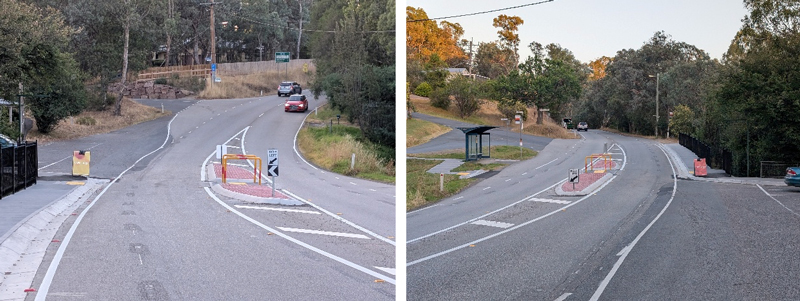
Russell Road, Mullens Road and Ringwood-Warrandyte Road intersection.
Manningham Council has completed works to improve pedestrian safety at the Mullins Road intersection, including a refuge, pathway and safety barriers.
Footpaths
At its meeting on 3rd March, Council approved a new footpath policy. It is not a one size fits all, and there will be different solutions for different communities. The WCA survey of Warrandyte residents in 2023, found strong support for footpaths that blend in with the environment, that are more winding, which avoid tree removal and use crushed rock and aggregate rather than concrete, in order to retain more water for vegetation and the environment.
Building Permits
From time to time the community faces instances where builders blatantly ignore the provisions of their building permit and attempt to construct dwellings which do not conform to the planning and building regulations. One such instance has occurred recently in Manningham where the builder has sought to amend the permit after undertaking works which effectively will turn a two-storey dwelling into a three storey one, impacting the neighbours adversely as well as exceeding the Warrandyte height limits. The WCA has urged Council to act to stop this practice of breaking the rules first then seeking permission after.
Right turn into Pound Road from Heidelberg Warrandyte Road
Some members have asked about a right turn lane into Pound Road for those heading west along Heidelberg Warrandyte Road. As the road is under the jurisdiction of the Department of Transport and Planning (DPT), Manningham Council is not responsible for such a development. Locals would have to make a request to DPT and it would be dependent on data in relation to accidents or near accidents, to determine the priority of such a lane.

In March Manning Council completed an Intersection Upgrade on Pound Road, at the Heidelberg-Warrandyte Road intersection, to improve safety and traffic flow.
WAVA – Warrandyte’s Volunteer Alliance Formed
On March 2 the WCA convened a meeting of community volunteer groups to discuss how these groups might collaborate and support each other. Eighteen community organisations met over a dinner provided by Now and Not Yet community cafe and agreed to set up a working party to advance the idea. It was a great display of community spirit and the diversity of volunteering in Warrandyte.
Integrated Water Management Strategy
Manningham Council has developed a draft Integrated Water Management (IWM) Strategy (2026 – 2036) for improving water outcomes for our community and environment. The Manningham documents include a Strategy (Part A) and a Background Report (Part B). A number of Warrandyte residents have participated in the Manningham Community Reference Panel.
The main strategic directions in the draft strategy include:
- Using Water Sustainably – To better manage our water resources and increase alternative water use in response to population growth and climate change.
- Improving Waterway Health and Biodiversity – To minimise the impacts of urbanisation and development by better managing stormwater entering our waterways.
- Improving flood management – To use a range of flood management measures to support drainage infrastructure to reduce exposure to flood risk.
- Increasing Community Understanding and Strengthening Partnerships – To work together so the Council, community, responsible agencies, Traditional Owners and other key stakeholders can help create a more culturally aware and sustainable future.
It is understood that the draft strategy will be considered by Council at its meeting on 24 March 2026.
Warrandyte Riverside Market
The WCA is an organising member of the monthly market committee. We have a wonderful team of WCA volunteers who assist with the “bump out” from 12.30-2.00pm, on first Saturday of each month. But of course we always need more. Please contact Dick on dickdockdavies@gmail.com if you can help.
Fuel Reduction
Roadside side-arm mowing
In preparation for the summer fire season, and at other times during the year, Manningham Council “side-arm mows” the edges of its bushy roadsides, particularly those east of Mullum Mullum Creek.
While we support this action, we have two concerns regarding the manner in which it is undertaken.
- the low-cut height of the side arm sometimes cuts into the soil below the grasses scouring the soil and leaving bare earth not just cut grass. This is not good soil management. It severely retards perennial species including any remaining indigenous grasses, and tends to result in replacement with weedy species that are bulky in their growth habit.
- the high frequency of this mowing is bad for the survival of sections of roadsides that have been mapped by the Council as high-quality vegetation. High quality is a technical term that means there are more varied indigenous species in a particular section than a section mapped as medium or low quality.
In these roadside sections a different approach to the side arm mowing is needed: lower frequency, and cutting of the grass around these more special species. This means use of a brush cutter and an operator that knows their indigenous storey species. After discussion, Council officers have proposed additional “Significant Road-side” signage and adoption of a more nuanced approach to grass cutting. We look forward to seeing this implemented.
Mulching for fire protection
Fuel reduction works are being conducted between December 2025 and March 2026 on Parks Victoria land between the Tank Track and Pound Bend Road. The aim is to reduce spotting from a severe wildfire (most likely from the north) into Bradley’s Lane and the Warrandyte township. This project, managed by the Department of Energy, Environment & Climate Action, commenced 23 years ago and is timetabled to occur every 10–15 years. The first two fuel reduction events here were control burns carried out in 2003 and 2015.
No control burns will be used in 2025-6. Instead, shrubby vegetation will be reduced through manual removal with ‘normal’ mulching and use of a less common method which involves mulching on the spot with a small ‘tractor’ called a Compact Track Loader. The aim is to leave 30 to 50 % of the shrubby (middlestorey layer) vegetation untouched. Targeted species are Cassinia and Kunzea that make up the bulk of the mid storey.
Untouched species will be the less common mid storey species, all Acacia acinacea stands (the form here is mostly knee high only) and all Eucalypts (dead or alive). Manual removal and associated ‘normal’ mulching will occur in the more sensitive areas. The remaining target stands will be mulched on the spot with the ‘Compact Track Loader’. The operator is instructed to work in such a way to minimize soil disturbance and for fauna habitat reasons to avoid logs larger than 10 to 15cm diameter. It is planned that later in the year, the small remaining Cassinia and Kunzea plants will be removed by spraying with herbicide. Long term future plans include introducing cultural burning practices into this cycle – this will leave portions of ground vegetation unburnt while still maintaining ecological and fire-management goals.
We appreciate DEECA efforts to reduce fire risk to the community and protect the native flora.
Next meeting is Wednesday 8th April, 7:30pm at the WCA office. Members welcome.